Monetary value
Merchant-specific prepaid balance, top-up, hold, debit, credit, refund and reconciliation.
From transaction validation and configurable rules to cross-merchant redemption, affiliate settlement, exception handling and analytics.
Merchant-specific prepaid balance, top-up, hold, debit, credit, refund and reconciliation.
Pending, available, reserved, redeemed, expired, revoked, reversed and locked points.
Points are a governed program value, not wallet money.
A customer can hold independent point balances for each merchant chain or program.
Monetary wallet ledger and point ledger never share a balance or state machine.
Issuer, eligible merchants, rights, expiry, limits and settlement are explicit.
Every earn, reserve, redeem, release, reverse, expire, revoke and adjustment is traceable.
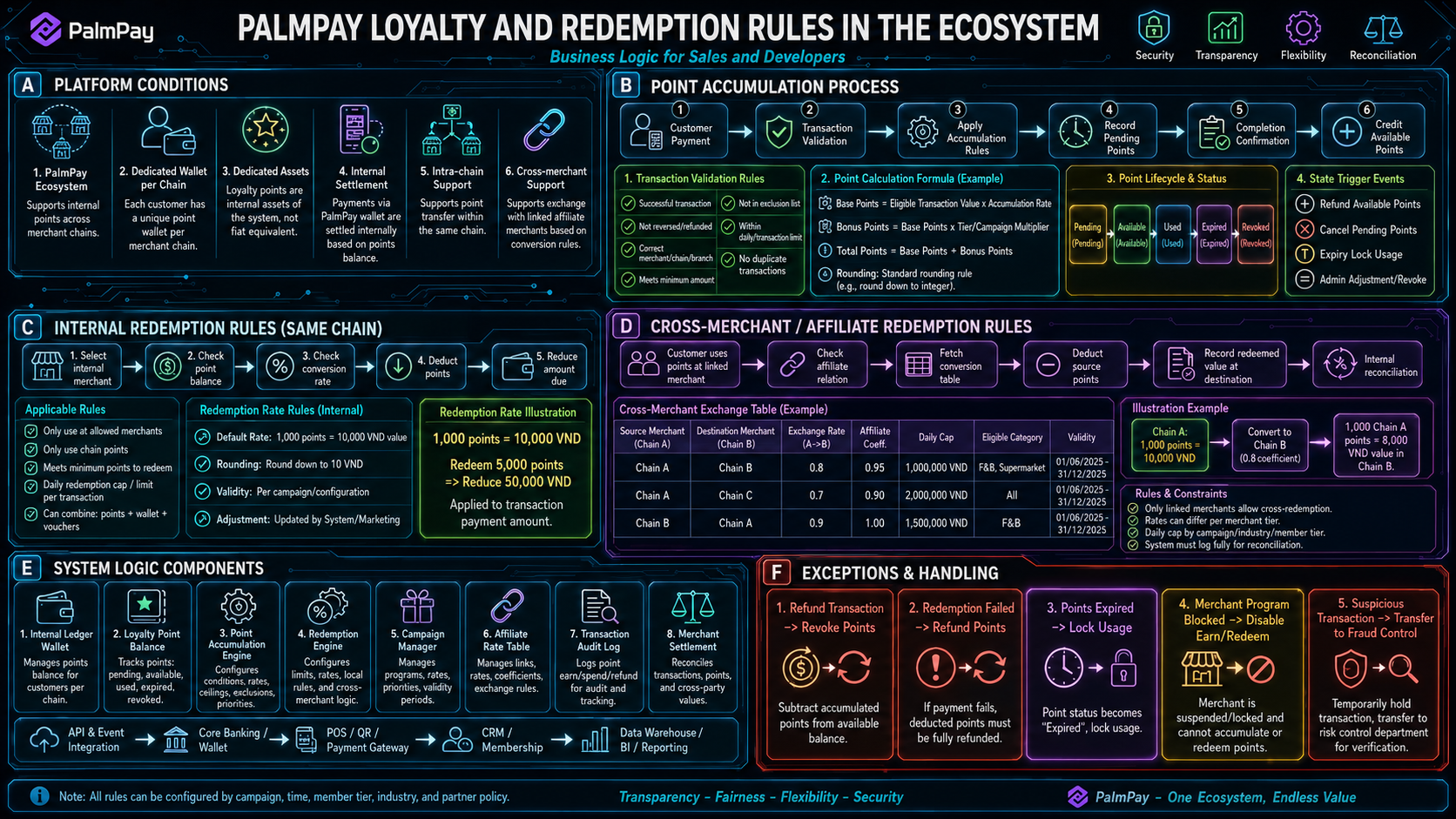
Validated transactions become controlled point entries.
Payment success, no refund, correct merchant/product/program, minimum amount, campaign period and fraud status.
Eligible amount × earn rate plus tier/campaign bonus, subject to cap and rounding.
Pending → Available → Reserved → Redeemed, with Expired, Revoked, Reversed and Locked branches.
Rates, budgets, cross-merchant exchange, mass adjustment and recovery require approval.
Three models share one central control plane.
Use points within the issuing merchant or chain, with minimum points and maximum invoice coverage.
Use source-chain points at an approved destination merchant through an exchange ratio and settlement agreement.
Exchange points for an approved external benefit while PalmPay retains the point ledger and audit.
Reserve first, confirm benefit, redeem on success or release on failure.
Financially meaningful loyalty needs failure-safe operations.
Reverse related points; handle already-redeemed points through policy, negative balance or manual review.
Release Reserved points back to Available when payment, voucher or partner confirmation fails.
Block earn/redeem, freeze affected points and route suspicious transactions to review.
Opening liability, issued, redeemed, expired, reversed, closing liability, payable and receivable.
Business users and developers see the same governed model.
Dashboard, campaign, earn/redeem rules, tiers, affiliate, ledger, exceptions, reconciliation, approvals and reports.
Programs, campaigns, rules, point accounts, transactions, redemptions, exchange rates and reconciliation.
payment.completed, loyalty.points.pending, credited, reserved, redeemed, released, expired and reconciliation.completed.
Earn rate, redemption, breakage, liability, repeat purchase, campaign conversion, fraud/reversal and cross-merchant usage.
PalmPay evaluates merchant eligibility, excluded categories, product conditions, campaign priority, member tier, daily and monthly caps, duplicate detection, fraud status and rounding in a deterministic order. Every rule decision should record the rule version and effective time so finance, customer care and audit can reproduce the outcome.
The issuing merchant defines the economic obligation behind points. Cross-merchant and affiliate use requires a clear conversion rate, funding owner, settlement period, fees, breakage policy, tax treatment, dispute process and responsibility when the destination merchant cannot fulfil the benefit.
The PalmPay Client should show available, pending, reserved and expiring points by merchant, the rule that created each entry, redemption value, restrictions and a complete history. Changes to material terms require controlled notice and, where applicable, renewed acceptance.
Bulk adjustments, reopening expired points, changing exchange rates, suspending a merchant and closing a reconciliation period should use maker-checker approval, reason codes and immutable evidence. Fraud teams need controls for velocity, circular transactions, repeated refunds, device anomalies and coordinated account behavior.
The related earn transaction is reversed. If the customer already spent those points, the program applies its approved negative-balance, recovery or manual-review policy without rewriting prior ledger history.
Yes, only when both merchants have an approved cross-merchant agreement, active conversion table, budget and reconciliation arrangement. The point ledger remains centrally controlled.
No. Points are program value governed by loyalty terms. Monetary wallet balance is a separate ledger linked to the merchant-specific prepaid model.
Marketing configures campaigns, finance monitors liability and settlement, operations resolves exceptions, customer care investigates history, risk reviews suspicious activity and administrators approve high-impact changes.
Mobile-ID will map commercial objectives to point liability, rules, portals, APIs, events, reconciliation and acceptance evidence.